With a second kid, a larger mortgage, and an unchanged desire to travel, I have had to pay more attention to optimizing credit card spend to generate points to use for airline tickets and hotel stays. As travel rewards cards have become more popular in the last 15 years, the opportunities to gain outsize value have decreased, but the fun challenge of constrained optimization is ever present. As I spent a lot of time strategizing my credit cards these last few months, one of my good friends, a guy who also likes to travel and has an infant, could not fathom why I would not just use a 2% cash back credit card. Immersed in the credit card world for so long, I thought it would be easy to convince him of the fallacy of his ways. When I recently redeemed 105,000 Chase points and 95,000 American Express points for a 5 day trip to Miami for my family of four, saving $5,000, I was sure I had finally convinced him. I had not. Chagrined but not defeated, I decided to demonstrate how using credit card signup bonuses generates a much greater equivalent cash back then 2%. The result is this post.
To incentivize new customers, credit card companies provide sign-up bonuses when you open a new credit card. For travel cards, the bonuses take the form of spending $X to get Y points. The points per dollar is then Y/X. For example, I recently opened the Chase Ink Business Preferred card to earn points to transfer to Hyatt (for the Miami trip). After spending $8,000, Chase gave me 100,000 Ultimate Rewards points, or 12.5 points per dollar. Different bloggers give different monetary values for a point, but for simplicity I will say they are worth $.01 each, a floor. That sign-up bonus therefore generated at least 12.5% cash back; even allowing for slippage, for me spending a little more than $8000, the cash back was not worth less than 10%. The Hyatt reservation I ended up making in Miami was worth $2700, or $.026 (2.6 cents) per point. At that value, I earned a minimum of 25% cash back.
A 25% cash back return is incredible. No credit card provides that return for ongoing spend. The closest you will get is when Rakuten and other shopping portals have bonus points earning. A sign-up bonus is better, however, because you get those points for any spending, not just spending at whatever vendor the portal provides enhanced earning on.
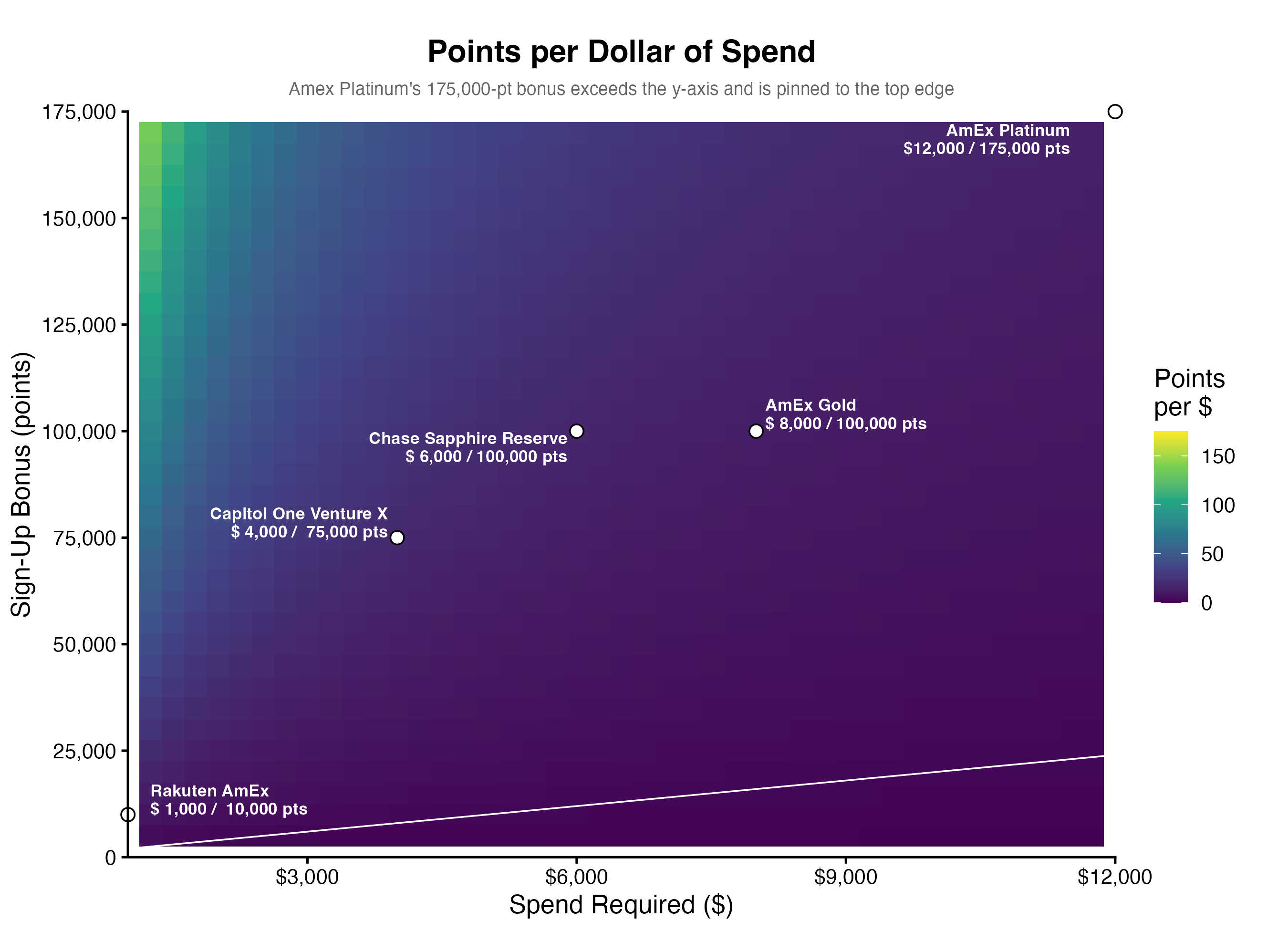
In a concession to today’s visual culture, I made a chart showing the relationship between a card’s sign-up bonus (y-axis), minimum spend threshold (x-axis), and the resulting points per dollar (color). I added a white line with a slope of 2, representing 2% cash back. The chart also includes points for popular travel credit cards’ signup bonuses as of September 20, 2026, plus the AmEx Rakuten I’ve raved about. The result is clear: you will always return much higher cash back equivalents by pursuing sign-up bonuses then relying on everyday spend. If you can hit the minimum spend, go open those credit cards!